Gender Representation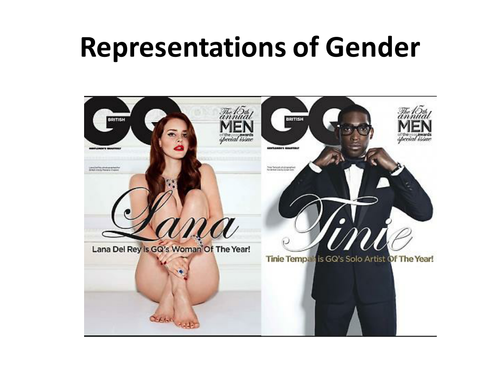
These two images are separate GO Covers for two artists. This relates to gender representation due to the different ways in which the pair are represented. For example, in Lana's cover she seems to be completely naked, and in Tinie Tempah's cover he is dressed very formally, and looks rather dapper. This could lead a viewer to decide that that women are represented as purely sexual objects and that the magazine wouldn't get attention unless Lana was naked. However, Tine is depicted in a suit and tie, which could lead to the viewer interpreting that men are more powerful and smart.
What is the Gaze?
The concept of gaze is one that deals
with how an audience views the people presented.
The Male Gaze 1975
In film, the male gaze refers to when the viewer is put into the perspective of a heterosexual man. It is only the male gaze if these curves are highlighted with specific conventions, such as slow motion, deliberate camera movements and cut aways.
Blurred Lines

The video very strongly complies with Laura Mulvey's theory of the Male Gaze. For example, the video features many close up shots emphasising the curves of the female body, as seen in the picture above. The woman is also making a very shocked expression which makes her appear innocent, and therefore more seductive. The men in the music video contrast with the women in that they are all dressed in smart attire, which makes them seem much more important, powerful and dominant over the women (even though there appears to be more women than men in the video).
Visual pleasure and Narrative cinema:
• Women
are
presented as sexual spectacle (show) objects of pleasure for the characters and
audience. She believed
that in films audiences have to view characters from the perspective of a
heterosexual male.
• Stating
that
the way women are viewed in cinema is ‘unequal’.
• The camera
necessarily present women as ‘sexualised for the pleasure of men.
• Men fetishies
women which she referred to as ‘fetishistic scopophilia.
• Men have
this gaze to avoid being ‘castrated’.

In this short clip from transformers the actress megan fox is portrayed as both intelligent and objectified. Although she speaks a lot of smart stuff about cars, the male character still finds it difficult to focus on the words she says and is instead more focused on her body. This can be seen as he does't look at her in the eyes when she speaks; he instead looks at her body. This suggests that men care more about women's looks and bodies than their intelligence. This complies with the male gaze due to the emphasis on the female body and camera shots of it. Also, due to editing. Whenever the camera is on Shia LaBeouf, part of Megans midriff and bottom is always visible. This shows that Megan is being objectified as the shots are more focused on her body than her face and speech. This also links to Mulvey's idea that women are presented as a sexual spectacle - i.e objects of pleasure for both the male character and the audience.
This is an advertisement for a new burger king meal.
In this advertisement there is a woman with parted
lips opposite the burger, captioned "IT'LL BLOW
(your mind away). I think that advertisers decide to
portray women in this way because "sex sells"-
meaning a man is more likely to buy a product if it is
advertised in a sexual nature. This helps advertisers to
better attract the male audience to their product as
stereotypically, men are perceived as all "sex
Facial Expressions
Women :
•Chocolate
box
•Invitational
•Super-smiler
•Romantic
or sexual
Marjorie
Ferguson (1980)
Men
:
•Carefree
•Practical
•Seductive
•Comic
Trevor
Millum
(1975)
EXAMPLES OF EMPOWERMENT IN CHARLIES ANGELS
1. The women do a lot of combat and fighting
2."I work for myself"
3. All of the main protagonists are seemingly female
4. Handling weapons
5. Dangerous sports
SEXUALITY
1. Lots of strippers
2. Women in bikinis, seem to be intimate.
3."ride it rough and hard"
4. The angels stripping
5. Tight revealing outfits
I personally believe that female representation has somewhat changed over the years, as nowadays there are many more films featuring female protagonists and demonstrating female characters as strong and independent. An example of this could be Frozen, in which the main protagonist is female, and the other character is saved by her sister, not a male love interest.
Jonathan Schroeder (1998)
“to gaze implies more than to look at –
it signifies a psychological relationship of power, in which the gazer is
superior to the object of the gaze.”
Fetishistic Scopophilia: deriving pleasure from viewing women
Stereotype: a widely held but fixed and oversimplified image or idea of a particular type of person or thing.
Counter Stereotype: an idea or object that goes against a standardized mental picture that is held in common by members of a group and that represents an oversimplified opinion, prejudiced attitude, or uncritical judgment.
There is a difference between someones sex and their gender. A persons sex is in reference to a persons physical characteristics - whether they are male or female. A persons gender is in reference to the socially constructed expected behaviour of a certain sex, for example girls are expected to wear dresses and boys are expected to be unemotional.
Misogyny: dislike of, contempt for, or ingrained prejudice against women.
From a media perspective, these magazines would suggest firstly that to be a boy you must be aggressive. This is implied from the "Fight!" cover line featured in the bottom right hand corner, and also from the fist that Ben is making in the top right corner. A lot of dark, dull colours are used, which makes the magazine look less exciting. It also suggests that boys should be intelligent as in the skyline at the bottom of the magazine it is detailed that there will be "facts" featured in the magazine.
As for the "Girl Talk" magazine, it is much more bright than the boys magazine. It suggests that females are a lot more excitable, for example a cover line reads "eek!". It also suggests that girls would perhaps be more focused on materialistic themes, for example theres an article about "celeb style", which leads to young girls focusing more on their appearance.
Can gender representations change over time?
I personally believe that gender representation will change as society changes. What is expected from both genders in society is rapidly changing as certain behaviours become more acceptable (female sexuality, male emotion, transgender/agender). This means that in order to keep up with the times media will need to update their representations in order to meet social expectation.
'Masculinity' is a concept that is
made up of more rigid stereotypes than femininity.
Representations of men
across all media tend to focus on the following:
•Strength - physical and intellectual
•Power
•Sexual attractiveness (which may be based
on the above)
•Physique
•Independence (of thought, action,
finances)
Earp and
Katz (1999) studies male representations in the media and found “a widespread
and disturbing equation of masculinity and pathological control and violence.”
They claim
that the media is responsible for a steady stream of images that define
‘manhood’
as connected with violence, dominance and control - and create it as
a normal and accepted
part of masculinity.
The Metrosexual
•One recent
development in the representations of masculinity is the Metrosexual ( mid
1990’s)
•The young
single man with a high disposable income, living in the city - as it is near to
the best shops. Metrosexual
man
is not gay but is often confused with being homosexual.
He is
objectified and sexualised
(turned into a sex object) which goes against traditional
representations of
masculinity
The Fool/ Buffoon
•The fool
stereotype is a tried and tested formula e.g. the
bungling father in TV ads and Sitcoms. Usually well
intentioned and light hearted, these characters range from slightly inept to
completely hopeless in work or parenting and domestic situations.
•On the
surface it may seem a very pejorative representation of men However
they
still always come out on top
Representations of women across all
media tend to
highlight the following:
•beauty (within narrow conventions)
•size/physique (again, within narrow
conventions)
•sexuality (as expressed by the above)
•emotional (as opposed to intellectual)
dealings
•relationships (as opposed to
independence/
freedom)
•Women
are often represented as being part of a context (family, friends, colleagues)
and working/thinking as part of a team. In drama, they tend to take the role of
helper (Propp) or
object, passive
rather
than active (Mulvey).
•Often
their passivity extends to victimhood. Men are still represented as TV drama
characters up to 3 times more frequently than women, and tend to be the
predominant focus of news stories.
In
Advertising and Magazines
They
are
shown as…
•Young
•Slim
•Overwhelmingly
white
•Conforming
to our image of ideal beauty (perfect skin, hair and alluring gaze).
In non Fictional Media
•women’s
roles
tend to be smaller and fewer than their male counterparts.
•Due to
the Patriarchal nature of our society - women are less likely to be the source
of leading news stories (politics, business, law and religion stories.)
•Since
their
roles in these areas tend to be fewer in number.
Pitbull Music Video
In the music video, the male characters are presented as powerful and dominant, and are often surrounded by multiple females, almost as if they own them. Female characters are presented as highly sexualised, all dressed in either their underwear or bikinis and posing lustfully. They also come across as quite submissive as the male characters seem able to easily influence and control their behaviour.
 - Cut 0.13


